Elliptic functions
In complex analysis, an elliptic function is a meromorphic function that is periodic in two directions. Just as a periodic function of a real variable is defined by its values on an interval, an elliptic function is determined by its values on a fundamental parallelogram, which then repeat in a lattice. Such a doubly periodic function cannot be holomorphic, as it would then be a bounded entire function, and by Liouville's theorem every such function must be constant. In fact, an elliptic function must have at least two poles (counting multiplicity) in a fundamental parallelogram, as it is easy to show using the periodicity that a contour integral around its boundary must vanish, implying that the residues of all simple poles must cancel.
The Weierstrass function.
The Weierstrass function (see http://people.math.sfu.ca/~cbm/aands/page_629.htm) is a complex-valued functions parametrized by two complex numbers and such that . The function can be defined through the following formula:
where summation is carried out only over those terms in the sum giving non-zero denominators.
The Weierstrass function is holomorphic (i.e. complex differentiable) except at the set of isolated points . These points form a regular lattice on the complex plane, the fundamental cell of this lattice having its vertices at , and the function is periodic in this lattice. Indeed, it follows from the definition that
We then say that is doubly periodic, and we call the numbers and half-periods. As a result the knowledge of on the fundamental cell of the lattices suffices to know the function on the entire plane.
It also follows from the definition that is an even function:
A mnemonic trick to remember the expression of the function to observe that can be obtained by the repetition of the pole on a lattice of the complex plane generated by the complex numbers and . The fundamental cell (also called fundamental parallelogram) of this lattice has edges and .
Elliptic functions and their main properties
Several properties of can be deduced from being meromorphic (i.e. holomorphic except at isolated points) and doubly periodic. These properties are so rich that they define an entire class of functions, called elliptic functions.
Using the double-periodicity property, and applying Cauchy’s residue theorem taking as contour of integration the boundary of the fundamental parallelogram, one can show that:
- the sum of the residues of an elliptic function, each taken with its own multiplicity, vanishes.
This result sets some restrictions on the type of singularities that an elliptic function may have. For example, an elliptic function cannot have a single first-order pole. It can have, for example, two first-order poles with opposite residues, or a second-order pole, as in the case of the function.
Based on this result, a clever use of Cauchy’s theorem shows that if is a (non-constant) elliptic function then
- the number of roots of the equation in the fundamental parallelogram is independent on and it is equal to the number of poles of in the cell, each taken with its order.
This number defines the order of an elliptic function. An important fact is that
- the order of an elliptic function is at least 2.
A further property of elliptic functions is that
- the inverse of an elliptic function, the derivative of an elliptic function, as well as any power thereof, is an elliptic function.
Given the casual look of the definition, the above result show that the class of elliptic functions has a well-defined structure, which is a striking fact.
A very good introduction to these and other results can be found in Neville’s book “Elliptic functions. A primer.”
The differential equation solved by .
The Laurent expansion of at the origin has the form:
where the numbers
are called invariants or moduli.
Since is holomorphic at points not coinciding with , it admits a complex derivative . Moreover, this derivative can be computed by termwise differentiation of the Laurent expansion of . Based on this fact, one can show that solves the complex differential equation:
A consequence of this property is the following inversion formula:
The right-hand side of the integral is an example of elliptic integral. 1
The inversion formula allows us to express the function in terms of and , rather than and , the usual notation being (here we follow the notation of Abramowitz Stegun). The complex pair , can attain any value, except those such that the discriminant
vanishes, which do not correspond to any choice of . In fact, if the discriminant vanishes, then the cubic polynomial has two coincident roots, and can be integrated in terms of elementary function.
The following Mathematica code makes it possible to visualize the dependence of the half periods on the invariants:
Manipulate[ComplexListPlot[WeierstrassHalfPeriods[{g2, g3}],PlotStyle -> PointSize[Large]], {g2, -1, 1}, {g3, -1,1}]
The borderline case , which can be attained, for example, taking and is degenerate, in that the second half period goes to . In fact, the command
WeierstrassHalfPeriods[{3., 1}]
yields the following output:
{1.28255,I \[Infinity]}
The locus of points where is real.
Most applications are covered when the invariants are real, and one is interested in knowing the locus of complex numbers for which is real. By the double periodicity of , it is sufficient to determine these points on the fundamental cell.
Using symmetry arguments, one can show that
- takes real values on the real an on the imaginary axis.
The locus of points where is real may however be larger. This depends on the sign of the discriminant .
The case .
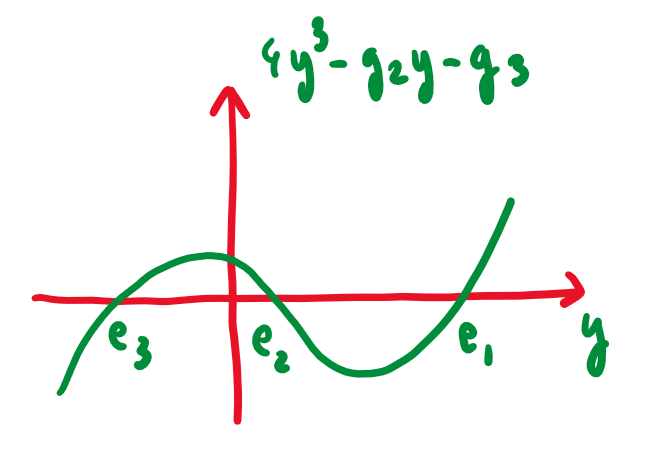
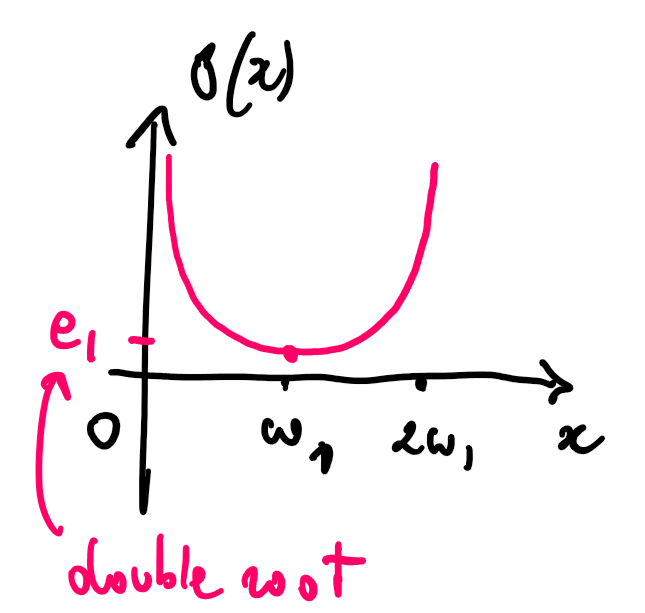
If , the cubic polynomial has three distinct real roots , , . Its typical plot is shown below:
Moreover, is real and is complex, and the unit cell is a rectangle:
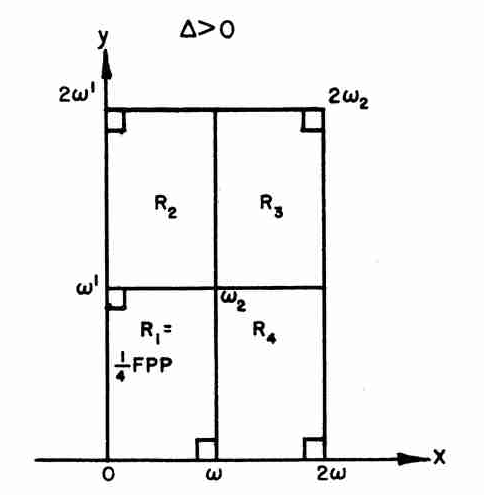
The complex numbers
are the vertices of the half unit cell.
The combination of periodicity implies that, besides symmetric with respect to the real and imaginary axis, the graph of the function is mirror-symmetric with respect to the horizontal and vertical axes passing through . 2 Then, the same token used to show that is real on the real and imaginary axes yields that
- is real on the horizontal and vertical axes passing through .
Similar symmetry arguments entail that is stationary at the vertices of the half cell:
By the differential equation governing , this implies that is a root of the cubic polynomial:
- the function attains the three roots at the edges of the fundamental pallelogram:
Further properties of relevant to applications are the following:
- The function is real on the vertical line passing through .
- By parametrizing the boundary of the half unit cell through a curvilinear coordinate starting from the origin and running counterclockwise, as shown in this figure
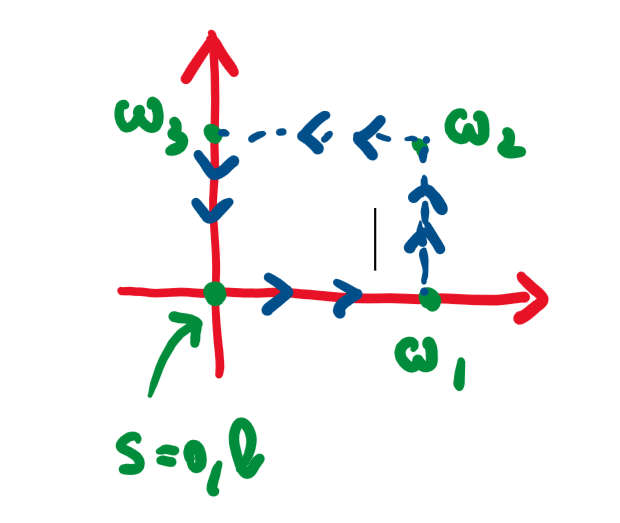
then the function has the following graph:
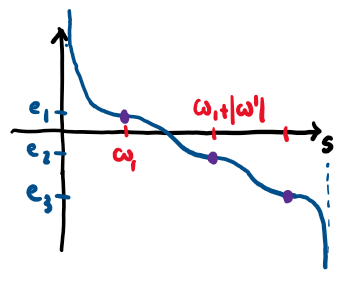
Along the perimeter of the half cell, the function is decreasing. Moreover, it attains once all real values
- in the interval along the horizontal segment connecting and tending to as .
- in the inverval along the vertical segment from to .
- in the interval along the horizontal segment connecting and .
- in the inverval along the vertical segment connecting and , tending to when the point approaches from above.
Uing these properties
The case
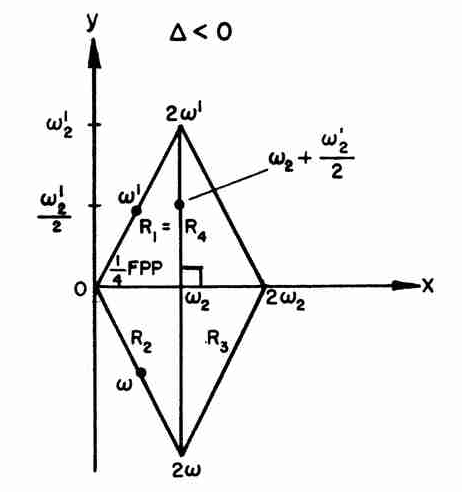
If , then and are complex conjugate, and the unit cell is a rhombus:
Application to differential equations
Consider the differential equation
It can be shown that if then the most general solution of has the form
If , the most general solution has two families of solutions:
where . The first family takes its values in the interval . The second family takes its values in the interval . Observe that, since the cubic polynomial is negative in the interval , no solution exists which takes its values in this interval.
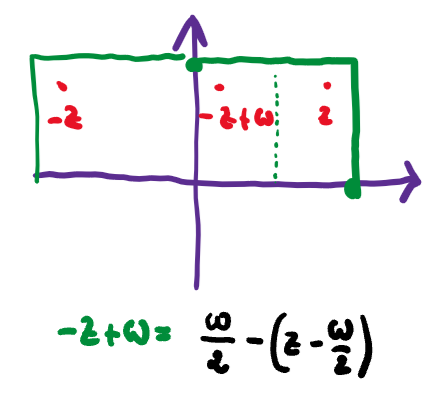
By symmetry, we have . Thus, by periodicity along , . But then, we can write , which shows that is obtained by mirror symmetry of with respect to the vertical axis passing through . A similar argument applies when we replace with . A consequence of this fact is, for example, that the graph of on the interval on the real axis is symmetric:
is called discriminant.
by means of the formula:
Mathematicians have realized that, instead of focusing on the properties of an indefinite elliptic integral, it is more convenient to focus on the properties of elliptic functions, which represent their inverses. This circumstance is not exceptional. Another example is the function, which could be defined by the inversion of the integral in for , through the identity:
This has led to extending to a complex function defined on the complex plane.
In some sense, is the simplest possible elliptic function that one can conceive, since it is obtained by double-periodic replication of the function (which is meromorphic with a pole of order 2 at the origin).