The critical load for the Euler elastica under compressive thrust
The boundary-value problem governing the equilibrium of an elastic rod with bending stiffness , loaded at its free end by a compressive thrust of intensity is
where . The problem admits the trivial solution for each . The system can be obtained by requiring that the energy functional
be stationary in the admissible set of of rotations which vanish at and whose first derivative is square integrable. The energy functional is convex for (see for instance Corollary 4.4 of https://arxiv.org/abs/2003.02696v1), which implies that the minimizer, and hence the solution of is unique.
We show that this bound is optimal by providing an example where uniqueness is lost as soon as .
To get a hint on how this solution may be constructed, we shall derive some necessary conditions which identify a monotone-increasing solution, and then show that these conditions are sufficient.
Thus, suppose that solves . By quadrature we find that
for some constant . Since , the constant is given by .
Integrating we obtain
In particular,
Conversely, suppose that the equation
admits a solution . Then for each the equation
has a unique solution . Moreover, the function solves the differential equation
along with and . The latter boundary condition implies, in turn, that , hence is a solution of .
To investigate the solvability of for , it is expedient to express the left-hand side in terms of elliptic integrals through the change of variable [1,Eq. 1.82]
The result is
where is the complete elliptic integral of the first kind whose graph, taken from [2,Fig. 12.1], is shown below, along with that of the complete elliptic integral of the second kind:
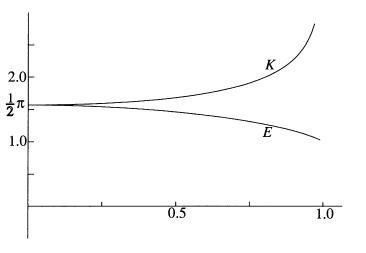
The function is increasing with and blows up as .
We conclude that the equation can be solved for every , and as a result the implicit formula provides a non-trivial solution.
Remark 1.
A formal argument to show that is the limit of the integral on the right-hand side of as is to carry out a Taylor expansion of the function at 0 up to second order, which would yield,
However, this argument should be made rigorous.
Remark 2.
We can think of as defining the compressive thrust that is needed for the elastica to attain the end rotation . Thus, our argument shows that the minimum value of the renormalized thrust needed to induce a non-null rotation is .
Remark 3.
If does not solve , then equation defines a function , where
This function solves
Thus, we may think of as defining the length that the cantilever should have to attain an equilibrium configuration under a renormalized thrust with end rotation .
References
[1] Davide Bigoni, Nonlinear Solid Mechanics, Cambridge University Press, 2012. DOI: https://doi.org/10.1017/CBO9781139178938
[2] Nico M. Temme, Special Functions: An Introduction to the Classical Functions of Mathematical Physics, Wiley, 1996. DOI (online version): https://doi.org/10.1002/9781118032572