Outline
The paper by Danas, Kankanala, and Triantafyllidis [^Danasetal2012] is concerned with the modeling of magnetorheological elastomers obtained by impregnating ferromagnetic particles (volume fraction 25%, saturation magnetization T) in a soft elastomeric matrix (incompressible rubber, with shear modulus MPa).
A microscopic inspection of these materials reveals that magnetic particles are aligned to form chains. These chains form because a magnetic field is applied during the curing process, which induces both mechanical and magnetic anisotropy.
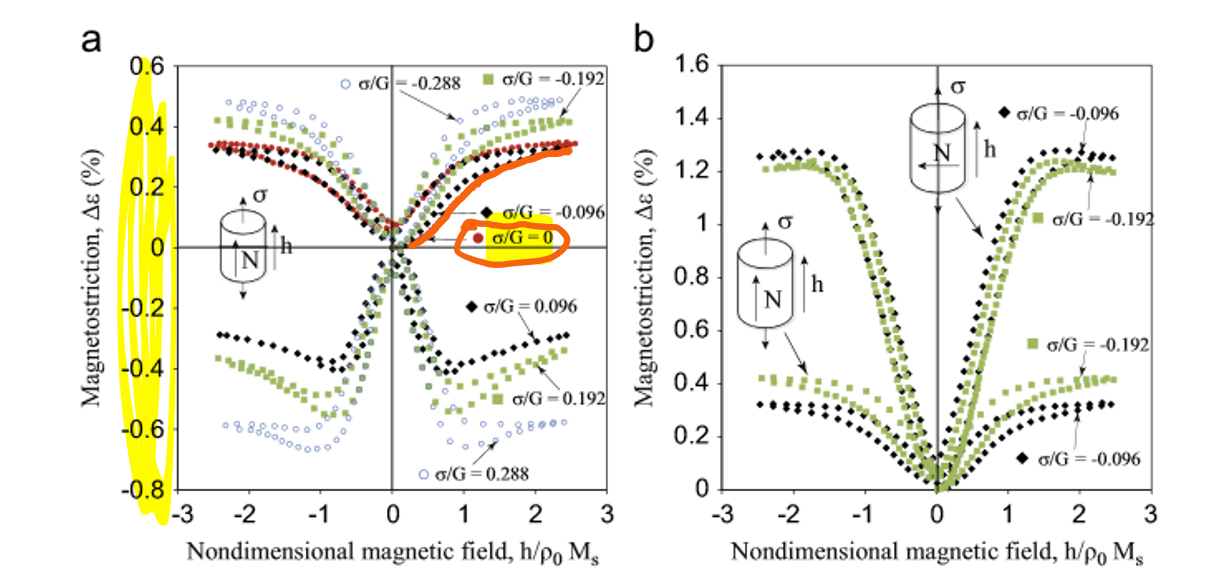
Experiments are performed by applying a uniaxial pre-stress to a sample and by measuring the axial strain and the magnetization induced by the application of a magnetic field parallel to the principal stress direction. The main findings of these experiments are summarized in the following curves:
In particular we observe that:
Magnetostriction is a second-order effect: the amount of pre-strain remains the same even if the applied magnetic field is reversed, for all amounts of pre-strains. However, the dependence of the magnetostriction changes in a marked fashion when the applied field exceeds the saturation value.
Magnetostriction is dependent on the amount of pre-stress.
- If pre-stress is null or negative, then the sample displays dilation upon application of the magnetic field.
- If a sufficiently large tensile pre-stress is applied, then the sample undergoes contraction.
Magnetostriction is sensitive on the relative orientation between the magnetic chains and the applied field/applied stress: if these two directions are orthogonal, then the magnetostriction effect is almost four times larger.
Magnetization curves appear to be not particularly sensitive to the applied pre-stress.
In general, magnetostriction effects are as much as twice as those in other magneto-elastic materials like Terfenol-D. Hysteresis is almost absent.
The authors argue that the observed behavior is consequence of the microstructure of the magnetic chains, which have a staggered alignment: the application of a magnetic field tends to align these particles on a line, thus creating an elongation in the direction of the chains. This effect ceases if the applied pre-stress is sufficiently large: in that case, the particles are already aligned, as shown in this figure:
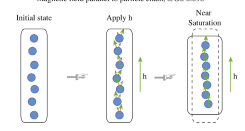
and hence the application of a magnetic field induces a reduction of the interparticle distance.
Modeling
Based on these experiments, and on consideration on material symmetry, a specific (i.e. per unit mass) free energy of the form
is proposed, which depends on the Green-Lagrange strain and on the specific magnetization . The free energy is constructed as sum of terms dependent on 10 invariants. Besides the standard five invariants for a transversely-isotropic material, one also has 3 invariants
and finally the mixed invariants
Note that the invariants from 6 to 10 are quadratic in . The magnetic field and the Cauchy stress are given by
and
Note that, although the Maxwell stress is symmetric, the magneto-mechanical stress may be not. Precisely, we have
On the other hand, the contribution to the magnetic field coming from the 10-th invariant is
The dependence of the free energy on the above invariants is postulated based on several experimental findings.
Since the effects of pre-strains on magnetostriction is relevant, the mechanical part of the free energy is typical from nonlinear elasticity, with several fitting coefficients and higher powers of the strains. On the other hand, when the magnetic fields are small, the magneto-mechanical coupling can be accounted for with only quadratic terms in the magnetization, that is , through the invariante
An additional term is included to account for large magnetic fields, which leads to the expression:
##
An important question, addressed by Silhavy, concerns the existence of solutions for the problem.
The constitutive modelling of magneto-rheological elastomers has been addressed in several papers. Among those, in particular, workers believe that the simples ones are those which express the strain energy as a function of deformation gradient and the Lagrangian magnetic field .
The advantage of using the magnetic field is that it is curl-free, and hence it admits a potential such that . The potential is the pull-back of the spatial potential in the reference configuration.
The materials considered in the present application have some peculiarities. In fact, unlike conventional magneto-sensitive elastomers, the orientation of the magnetization is imprinted after the material has been cured. Thus, unlike conventional MRE, these materials do not display the typical chain-like structures.
Moreover, these materials are crafted in the shape of thin rods undergoing large displacement and large rotations, but relatively small strains.
Furthermore, the applied fields are also expected to be moderate, such that they do not modify the magnetization of the specimen.
In addition, the constitutive response should be transversely-isotropic.
Summing up, the theory has to be suitable to describe magneto-sensitive elastomers undergoing:
- small strains, small applied fields, but large rotations.
The dimension reduction techniques that can be used are
A reason for using the magnetization as state variable is that
On the other hand, workers believe that