Laplace operator in spherical coordinates
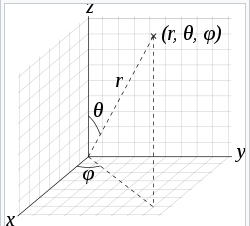
We adopt the standard convention from physics, whereby is the polar angle (also referred to as co-elevation) and is the azimuthal angle, as shown in the figure below:
We denote by the corresponding orthonormal basis, which we show in the following sketch:
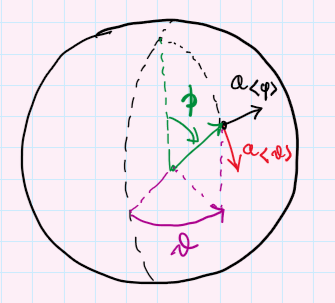
We find it convenient to think of and as scalar fields defined over the sphere. A direct calculation yields the following relations:
The adoption of and turns into a particularly handy notation when expressing the gradient of a scalar field :
Here we associate a the numerical indexes and , respectively, to the coordinates and , and we use a comma to denote partial differentiation, so that, given a scalar field , the symbols and denote the partial derivatives of with respect to and , respectively; moreover, when performing summations we adopt Einstein convention, with Greek letters for dummy indexes that run over the set .
The Laplacian of a vector field is then:
By observing that and that , we compute