Surface growth
There are several problems from engineering, material science, and biology, which involve an elastic solid undergoing accretion at its surface. The solidification of an alloy at the interface with its melt, the process of growth by chemical vapor deposition, provide classical examples. More recent applications are concerned with 3D printing and layered accretion (see for example Mech. Based Design of Structures and Machines 40 (2): 163–84), as well as the growth of hard tissues like bones and teeth (see for example Int. J. Engineering Sci.127: 53–79).
Under certain circumstances, surface growth can be responsible for generation of stress in the body.
- The most obvious example is a body growing against fixed external constraints, which can become incompatible with is shape as growth proceed.
- In other circumstances, growth may generate residual stress due to incompatibility between the stress-free states of different point of the body. In this respect, the way material is added to the body can have strong influence on the stress state. This has also suggested the idea that one may design in advance the accretion process in such a way to obtain a desired residually-strained unloaded configuration, as discussed for example in Phys. Rev. Lett. 119 (4): 048001
3D printing, thin-film epitaxy, and the development of horns in rhinos have in common the fact that addition of new material takes place at the surface. Nevertheless they are completely different processes, and hence require a totally different model. In fact, in 3D printing accretion does not take place simultaneously at all points of the surface, and accretion rate is dictated by the deposition device; in thin-film epithaxy, on the other hand, growth takes place on an entire surface, but its rate is dictated by the physical and chemical properties of the surface and the growing conditions.
It is important, to make a distinction between growth and accretion. Central to the derivation of laws governing accretion is the notion of chemical potential of a solid. We learn from Freund (1998) that this notion already appears in the work of Gibbs, in a paper published in 1928, concerned with the chemical equilibrium between a deformable solid in contact with a solution saturated with the same material in dissolved form.
Further contribution comes from Herring (1953) , which dealt with the process by which highly compressed powders are converted into solids by curvature-driven mass transport at elevated temperature during sintering.
Rice and Chuang (1981) added stress effects to Herring's curvature effects to broaden the applicability of chemical potential as a surface field driving mass transport.
The fundamental interface problems of solidification and heat treatment of crystals, polycrystals and alloys are reviewed by Leo and Sekerke (1989) who focused on the effects of surface stress at finite strain on chemical equilibrium of interfaces. In recent years, the challenges of fabricating high quality material nano-structures, mainly for microelectronic appli-
Rice and Chuang added stress effects to Herring's curvature effects to broaden the applicability of chemicalpotentialasasurface_elddrivingmasstransport[Thefundamentalinterface problems of solidi_cation and heat treatment of crystals\ polycrystals and alloys are reviewed by Leo and Sekerke "0878# who focused on the e}ects of surface stress at _nite strain on chemical equilibrium of interfaces
All these papers have in common the idea of allowing, among all possible variations, those which involve a change in the collection of material points that comprise the body. In particular the calculation of Freund (1998) (see here) for additional details), shows that when the domain is changing, under the assumption that there is no misfit between the new material and the pre-existing one, then the time derivative of the free energy can be given the form
where V is the normal velocity in the reference configuration
where \mathbf n denotes the unit normal in the reference configuration. It is important to keep in mind that the normal velocity has no connection with the deformation. It is the velocity of growth
Growth-induced mechanical instabilities
Growth of an elastic body can induce mechanical instability. As an example, consider an Euler beam constrained between two simple supports placed apart at distance \ell_0. Suppose that the beam can undergo growth, in the sense that its natural length \ell can change. The compressive force in the beam is then P=EA(\ell_0-\ell). Accordingly, the beam buckles when the length reaches the critical value \ell_{\rm crit}=\ell_0+\pi^2\frac{EI}{EA\ell_0^2}.
A one-dimensional example of unstable growth
A more interesting instability phenomenon can take place when the evolution law that governs the length of the beam depends on the stress. This type of instability has been discussed in the paper [@Abeyaratne2019] in a broader context, inspired by experiments on actin growth.
The mechanical system studied in [@Abeyaratne2019] consists of a one-dimensional elastic bar clamped on one side and constrained at the other side by an soft device, as shown in the figure.
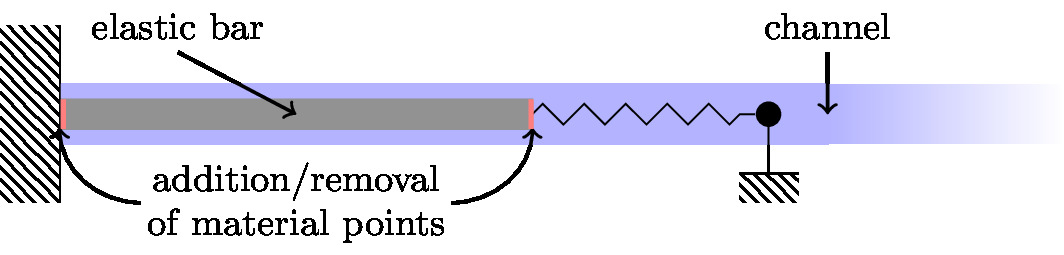
The bar is immersed in a semi-infinite channel containing flowing particles. These particles can attach/detach at/from the terminal sections of the bar. Thus the bar can change its stress-free length \ell according to a kinetic equation of the form \dot\ell=f(\sigma), where \sigma is the traction. The function f is monotone decreasing
Elementary considerations of mechanics allow to express the traction \sigma as a function of the stress-free length: \label{eq:1} \begin{aligned} \ell=g(\sigma). \end{aligned} The functions f and g depend on the values of certain parameters, such as the stiffness of the bar, the stiffness of the spring, the mobility of the flowing particles, etc. The construction of the full mathematical model, as well as its analysis, is indeed quite elaborate, and we refer to [@Abeyaratne2019] for details. In brief, the main finding of the analysis is that for some choices of the parameters the system can reach a stationary state (the so-called treadmilling state) such that the stress-free length stays constant. However, for other choices \ell converges to zero and the body can shrink to a point. This latter case constitutes an example of unstable growth.
Central to the treatment is the following expression of the driving force:
The interpretation is the following: the first term is the strain energy necessary to build up new material. The second term is the work required to, quoting Asaro and Tiller, "push back" the loading mechanism.
Note that the bar can undergo only axial displacement. As a result, the bar can stretch but cannot bend, and in particular it cannot buckle. In summary, this problem provides an example of how introducing growth may produce instabilities in an otherwise stable elastic system.
- A discussion on the result of the paper can be found here.
- Various notes and questions about the paper can be found here
Asaro and TIller
A more complex example: instability of a half space
In 1963 Biot showed that the equilibrium state of a uniformly pre-stretched, homogeneous elastic half space composed of a neo-Hookean material becomes unstable at a critical value \lambda_c of the pre-stretch \lambda.
If the material is incompressible, the deformation gradient has the form \mathbf F=\lambda\mathbf e_1\otimes\mathbf e_1+\frac 1\lambda\mathbf e_2\otimes\mathbf e_2, where \mathbf e_1 and \mathbf e_2 are, respectively, a horizontal and a vertical unit vector.
It is interesting to consider what happens when the free surface grows according to the kinetic law obtained in [@tomassetti2016]. When, as in the present case, the surface of the body is traction-free, the kinetic law in question takes the form \label{eq:1} bV=k-\psi(\mathbf F), where V is the normal velocity of the boundary in the direction of the exterior, b>0 is a kinetic modulus, k\in\mathbb R is a constant,and \psi is the strain energy.
The result of this analysis1 is that the boundary of the half plane develop ondulations in the undeformed configuration as soon as it undergoes tension, that is, when the stretch in the direction parallel to the plane is greater than 1.
This preliminary result is an indication that additional ingredients should be put in the model to make it stable. A possibility we are exploring at the present moment is the inclusion of surface tension in the model.
The role of surface tension
Instability of an elastic body in the general case
Here you can find a note on how the solution of an equilibrium problem in elasticity is affected by a perturbation of the domain.
Here you can find a note on how the solution of an equilibrium problem in elasticity is affected by a perturbation of the domain in the three-dimensional case.
3D Printing
Papers
In this paper, taking the cue from experiments on actin growth on spherical beads, we formulated and solved a model problem describing the accretion of an incompressible elastic solid on arigid sphere due to attachment of diffusing free particles.
1
M.A. Biot. . App. Sci. Res. 12 (2): 168--82. https://doi.org/10.1007/BF03184638.
R. Abeyaratne, E. Puntel and G. Tomassetti. . ArXiv preprint: https://arxiv.org/abs/2001.00510.
G. Tomassetti, T. Cohen, and R. Abeyaratne. . , 96:333--352, 2016. ArXiv preprint: https://arxiv.org/abs/1603.03648
Asaro and Tiller develop a notion of chemical potential of a stressed solid. The heart of their argument is the following calculation
An intuitive interpretation of this expression is provided by Asaro and Tiller.
Classical elasticity requires that the equilibrium state of a body is the one in which the quantity, V, defined as
They consider the potential energy